

Look
Building a healthy mind
We spend a great deal of time thinking about our physical health. We know we should eat well, exercise and get enough sleep. But how much thought do we give to the things our minds need to stay healthy?
A friend recently shared the Healthy Mind Platter with me, developed by psychiatrist and neuroscientist Dr Dan Siegel, together with David Rock. It’s a simple framework that identifies seven activities that contribute to mental well-being: sleep, physical activity, focused work, meaningful connection, play, downtime and time for reflection.

This model reminded me that being productive is only one part of a healthy life. Rest, play, relationships and even doing absolutely nothing are important too. And while we might be good at some of these, others tend to fall away when life gets busy.
It’s a useful little exercise to reflect on how you spend your days. Which parts of your platter are getting plenty of attention, and which are being neglected?
Perhaps the answer isn’t to squeeze more into your day, but to make room for something that’s been missing.
Explore the Healthy Mind Platter and its seven elements here.
Listen
Why does South African savings not translate into infrastructure investment?
In 2022, South Africa increased the offshore investment allowance for retirement funds from 30% to 45%. Finance Minister Enoch Godongwana has since described the decision as a “mistake”, amid concerns that allowing more retirement savings to flow offshore leaves less capital available for investment in South Africa’s economy and infrastructure. But is this really what is holding back investment?
In this episode of The Allan Gray Podcast, Thalia Petousis, Sandy McGregor and Raine Adams challenge this thinking.
They argue that South Africa doesn’t lack capital, but rather enough attractive, viable investment opportunities. Substantial private-sector investment in renewable energy shows that money is available when the opportunities make sense. They also explain how offshore investment can ultimately benefit the local economy as foreign investment returns flow back into South Africa.
This conversation also makes an important case for global diversification.
The South African stock market is increasingly concentrated in a few sectors, particularly mining and banking, leaving investors with limited exposure to many of the industries driving global growth. Restricting offshore investment could increase risk for retirement savers without necessarily solving our infrastructure challenges.
Thus, the tricky solution lies in creating more opportunities worth investing in, rather than forcing retirement savings to stay at home.
Learn
Will the future of expertise lie in judgement?
Artificial intelligence is changing how we work, learn, and make decisions. But does having access to such powerful technology mean we’ll make better decisions?
An interesting study by Boston Consulting Group and researchers from Harvard Business School and other universities tested this question. More than 750 consultants were given professional tasks, some with access to AI and others without. The results were striking.
When AI was used for tasks it handled well, the quality of their work improved by more than 40%. BUT when consultants used it for more complex business problems outside its capabilities, they were 23% less likely to arrive at the correct solution than those working without AI.
The researchers describe this as the jagged technological frontier. AI can be exceptionally good at one task and surprisingly poor at another that appears very similar. The challenge is knowing the difference, particularly when its answers sound so convincing.
This study was conducted in 2023, and even though AI abilities are improving at the speed of light, it raises an interesting question about the future of professional advice. I believe that, as information and technical analysis become increasingly accessible, the real value of expertise will lie in judgement. Knowing what to trust, what to question and how to apply that information wisely.
Ponder
In this section, I invite you to think about a question I may pose or a thought I may share.
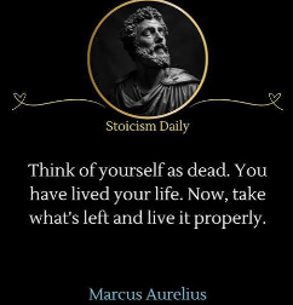
Marcus Aurelius isn’t being morbid. He’s encouraging us to imagine that the life we’ve lived until now is complete, and that whatever time remains is a second chance to live more intentionally. It’s a reminder that life is finite, that much of what we worry about doesn’t really matter, and that we shouldn’t put off enjoying the life we have.
Oenophilia
“Oenophilia simply refers to enjoying wine, often by laymen.”
There’s something wonderfully unpretentious about a wine called Disdit. Afrikaans for “This is it!” Johan Heyns, a former lawyer and filmmaker turned farmer, and Sue established Anysbos in the Botrivier Valley in 2008, with Sue bringing her IT experienceto the venture.
Marelise Niemann, also known for her own Momento wines, is the winemaker.
Their story is one of experimentation, perseverance and learning from mistakes. From understanding the challenges of different soils and slopes to turning invasive Port Jackson trees into useful vineyard mulch, they’ve learnt to work with nature rather than against it. choice.
Cape White blends are a niche category, but they produce some spectacular wines. The 2024 Anysbos Disdit is rich and textured, with aromas of white peach, nectarine and delicate florals. Its got vibrant acidity, perfect for our warm summer evenings. I recently enjoyed it with good friends whilst walking a trail in the Kruger.

This is my last newsletter for the year. As the year comes to an end, perhaps it’s a good time to take Marcus Aurelius’s advice. To slow down, let go of what can wait, reconnect with the people and things that matter most, and give ourselves permission to rest and recharge.
After all, the point isn’t simply to get more out of life, but to be more present for the life we’re already living.
Stay curious,
Elke Zeki