

Global equity markets made modest gains in the third quarter, returning 1,6% in US dollars after a strong second quarter. Resilient economic growth and solid company earnings outweighed three significant headwinds: higher oil prices, a sell-off in AI-related equities in July and a shift by central banks towards raising interest rates. Emerging markets were flat for the quarter but remain well ahead of developed markets for the year.
South African equities ended the quarter almost unchanged. The quarter fell into two phases: a rally in gold and platinum that lifted the market in August, before lower metal prices, an interest rate hike by the Reserve Bank and rising global bond yields reversed most of those gains in September.
The rand followed a similar pattern. It strengthened to below R16,00 to the dollar in early September, then weakened as rising US bond yields drew capital towards dollar assets, ending the quarter roughly where it began.

Source: PortfolioMetrix
What shaped global markets?
Oil, bond yields and a more selective AI trade
Oil returns as a key driver of inflation
The fragile peace we noted last quarter did not hold. The ceasefire between the US and Iran broke down in July, disrupting oil supply through the Strait of Hormuz. Brent crude rose from below US$80 a barrel in June to around US$104 by quarter-end and talks to reopen the strait remain stalled.
Higher oil prices feed directly into inflation through fuel, transport and food costs, and were the main reason many central banks changed course this quarter.
Global bond yields climb to multi-year highs
By September, most major central banks were raising interest rates. The US Federal Reserve raised rates for the first time since 2023, the European Central Bank and the Bank of Japan raised rates again, and the Bank of England signalled that it may follow. Markets expect further increases into 2027.
The US 10-year yield climbed above 5% for the first time since 2007, pushed up by higher inflation, a strong economy and heavy government and corporate borrowing. Investors also demanded a higher return for lending money over long periods, given the risk that inflation remains high and government debt keeps rising. Yields in Europe, the UK and Japan also reached multi-year highs.
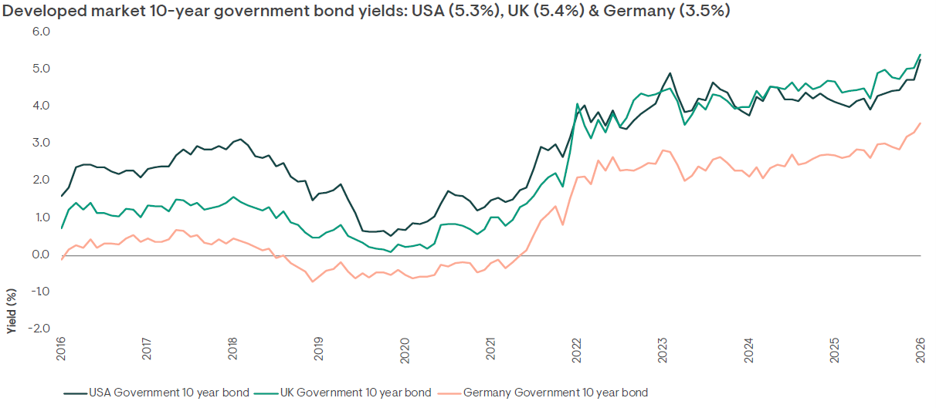
Source: Ninety One
US government bonds now pay more than three times the income they did in 2021, and that income has offset most of this year’s price declines. Higher starting yields have historically pointed to better long-term bond returns, and they give bonds more room to rise if growth slows, strengthening their role as a counterweight to equities.
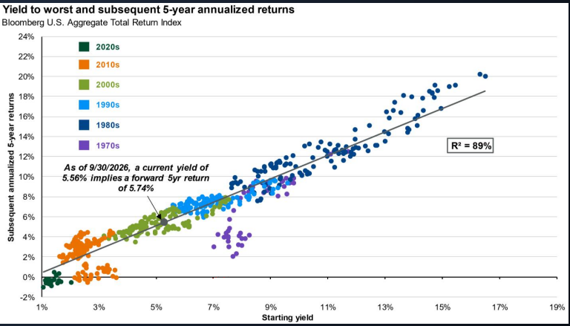
Source: PortfolioMetrix
Higher interest rates are not necessarily bad for equities. Since 1990, the S&P 500 has on average gained more in the three years after the Fed raised rates than after it cut them, because central banks tend to raise rates when the economy is strong. This quarter, resilient growth and solid profits kept equity markets higher, although rate-sensitive areas such as smaller companies, property and utilities lagged.
AI equities: a sell-off, then a more selective market
AI remained the main theme in equity markets, but investors became more selective. Chip makers sold off sharply in July as investors questioned whether the heavy spending on AI would pay off, with South Korea, last quarter’s strongest market, among the hardest hit. Strong company results drove a recovery in August, and leadership broadened from hardware towards software and consumer applications. US equities look cheaper than a year ago relative to earnings, yet by most other measures they remain among the most expensive they have ever been. With the market also highly concentrated, this is not a reason to sell, but it does point to more modest returns ahead and the value of staying diversified.
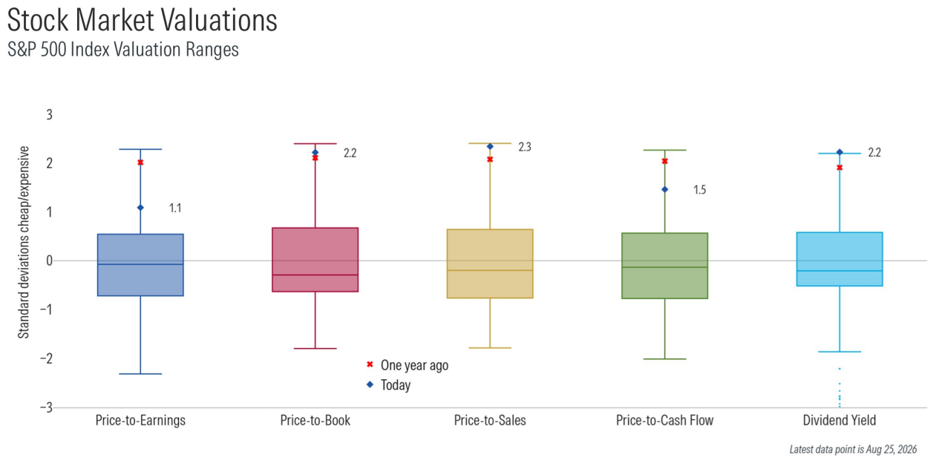
Source: Morningstar
Gold came under pressure from higher interest rates and a stronger US dollar, ending the quarter well below its January record.
What happened in South Africa?
SA equities and resources
After a difficult second quarter, resources led the local market. Gold and platinum miners rallied in August but gave back much of those gains in September as metal prices fell, while Sasol stood out on higher oil prices. Financials and industrials ended the quarter lower, with Naspers and Prosus also declining.
Rates, growth and local assets
Inflation edged up to 4,4% in August, still above the Reserve Bank’s 3% target. After holding rates in a split vote in July, the Reserve Bank raised the repo rate by 0,25% to 7,25% in September, this time unanimously, taking the prime lending rate to 10,75%. It cited the renewed inflation risk from higher oil prices and expects inflation to peak above 5% before year-end.
Growth remains weak. The economy contracted by 0,2% in the second quarter, its first decline after six quarters of growth, leaving the Reserve Bank raising rates into a soft economy. There were some positives: a mining-driven tax windfall strengthened the fiscal position, and the extension of the AGOA trade agreement to 2028 preserves duty-free access to the US for many South African exports.
Rising US bond yields drew capital away from emerging markets, including South Africa. Local bond yields rose, and both bonds and listed property ended slightly lower, making cash the best-performing local asset class this quarter. Over the past 12 months, however, South African equities, bonds and property have all delivered better returns than cash.
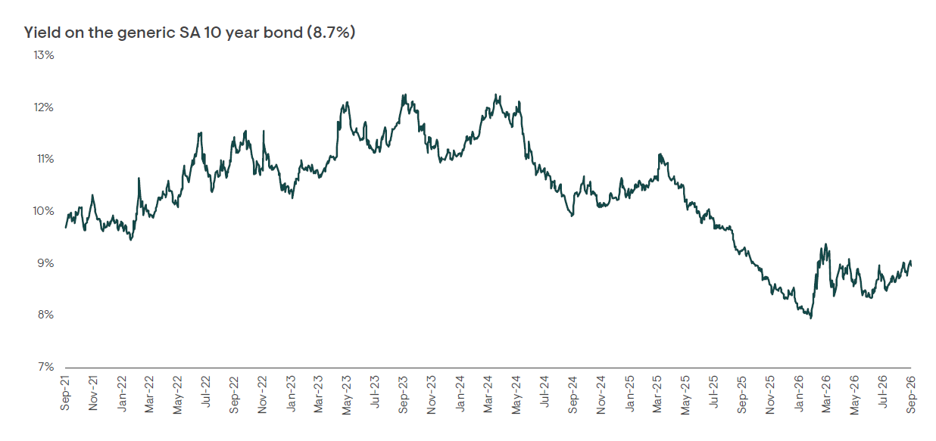
Source: NinetyOne
How did our portfolios perform?
Local portfolios were broadly flat over the quarter, returning between -0,3% and 0,8% depending on risk profile. Over the past year, they returned between 8,3% and 10,2%. This is comfortably ahead of inflation at 4,4% and about two to three percentage points ahead of the average comparable multi-asset fund.
Year to date, the more conservative portfolios have slightly outperformed the more growth-focused ones. That’s because growth portfolios hold more South African equities, which are down 3,2% YTD, while conservative portfolios hold more cash and bonds, which have delivered steady returns.
Global portfolios returned between -0.7% and 1,5% in US dollars over the quarter, and between 9,2% and 15,8% over the past year. With the rand ending the quarter unchanged, returns in rand were very similar to returns in US dollars.
What to keep an eye on
Oil remains the key variable: while the Strait of Hormuz stays disrupted, central banks are likely to keep rates high or raise them further. Locally, the 4 November local government elections will test the stability of the Government of National Unity, though the market impact is likely to be limited.
Valuations also matter. US equities are priced for strong profit growth, leaving little room for disappointment if AI spending slows. South African equities, by contrast, look attractively valued relative to global markets, trading well below their long-term average, which has historically supported better returns.
Periods like this remind us why we build portfolios around a long-term strategy rather than the latest headline. This quarter, gold and platinum rallied and fell back, AI equities sold off and recovered, and cash briefly led local markets. No single forecast would have captured all of that.
As the chart below shows, the leading market keeps changing, and no one can reliably predict which will be next. Diversification can feel frustrating when one market races ahead, but it means outcomes do not depend on picking the winner, and it limits exposure to the losers. Over a full cycle, a portfolio built around long-term goals rather than the latest headlines is better placed than those headlines suggest.

Source: PortfolioMetrix
Read the full PortfolioMetrix quarterly local report here, and the full quarterly offshore report here.
<Foundation Family Wealth is an Authorised Financial Services Provider>