
Look
The conversation many are not having
This graph from the Oath Money & Meaning Institute’s Q2 2026 survey stopped me. When retirement-age Americans were asked how often their financial advisor raises non-financial questions about purpose, identity, and how they want to live after work, 40% said those conversations don’t happen. Another 35% said only sometimes.
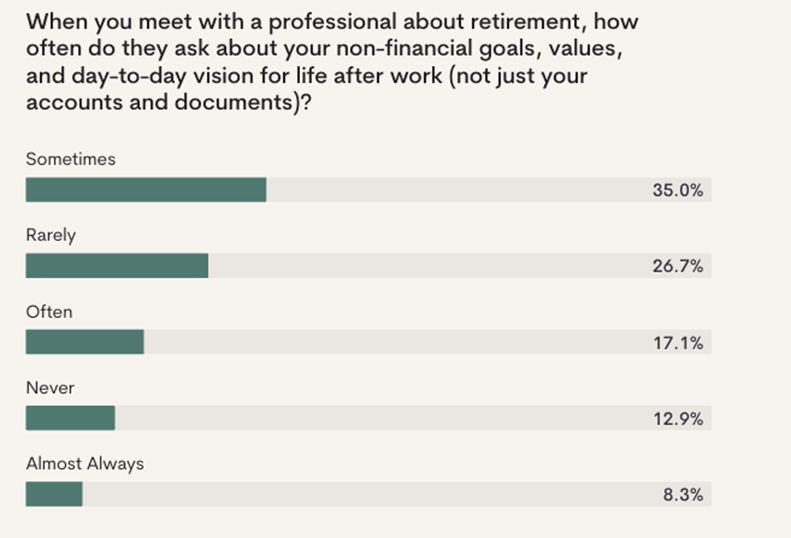
Source: Oath Money & Meaning Institute · Q2 2026
What makes this striking is what sits on the other side of the data. 81% percent said they are comfortable discussing exactly these topics. They are not avoiding conversation. They simply aren’t being invited into it.
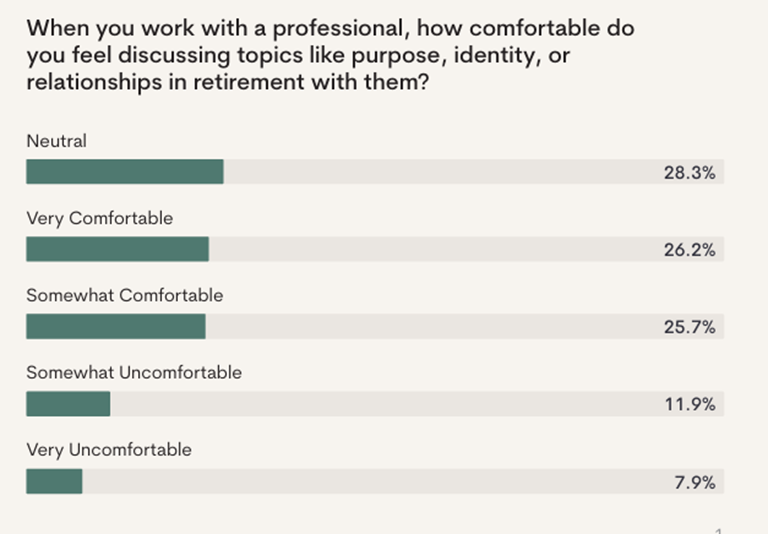
Source: Oath Money & Meaning Institute · Q2 2026
And what do people expect to give their lives meaning in retirement? Only 2% say money. Most see it as a safety net or something that reduces anxiety and makes other things possible. The real anchors are time with family (70%), travel, friendships and hobbies. Not the balance sheet.
At Foundation, these are the conversations we try to have first. The numbers matter deeply. But the question of what the numbers are for is the one that makes the real difference.
Read the full survey here.
Listen
Break the bad news bubble
Angus Hervey is the founder of Fix the News, an independent publication built on a simple but powerful idea. He says the biggest problem in media today isn’t left versus right, or the filter bubbles. It’s the bad news bubble. The news tells us what goes wrong. It rarely tells us what goes right.
In this TED conversation, Hervey runs through a handful of stories that barely made headlines. AIDS deaths are down 69% since their 2004 peak. The Brazilian Amazon has seen a 45% decline in deforestation in a single year. China hit its 2030 wind and solar target six years early and may have already reached peak carbon emissions. School meals now reach 480 million children globally, up from 390 million before the pandemic.
What I find most compelling is the distinction Hervey draws. He is not suggesting that terrible things aren’t happening. He is saying that not everything happening in the world is terrible and that the invisibility of good news has real consequences for how we see the future, and how much we believe change is possible.
Worth 20 minutes of your time.
Watch the video here.
Learn
When money gets personal
Money is often described as a top source of stress in relationships. This piece by financial planner Kimberly Foss, writing in Rethinking65, reminds us that it rarely stays theoretical.
The trigger is often children. Foss describes a client couple she calls Sam and Janet, at odds over how much support to give their adult daughter. Janet, protective and generous, wanted to help. Sam, more cautious, worried about enabling dependency. Neither was wrong. They simply had different instincts about what money is for, and those differences had been quietly accumulating for years.
A recent Bankrate survey found that 40% of adults in committed relationships admit to concealing financial information from their partners, including overspending, secret accounts, and hidden debt. Financial infidelity is more common than most of us would like to believe, and often rooted in conflict avoidance rather than deception.
Foss offers four practical principles for navigating these moments.
- Understand that money means different things to different personality types.
- Slow down and listen to each other.
- Find common ground and put shared goals in writing.
- Remember that taking care of yourself financially isn’t selfish. It is essential.
The piece is written for advisors, but it reads just as well for anyone approaching retirement in a relationship. Understanding how you and your partner think about money, i.e. where you agree and where you disagree, is some of the most important planning you can do.
Read it here.
Ponder
In this section, I invite you to think about a question I may pose or a thought I may share.
Do you and your partner talk about money? Not just the numbers, but what do you each want the money to do?
Oenophilia
“Oenophilia simply refers to enjoying wine, often by laymen.”


Cinsault is one of the Cape’s oldest varieties. The varietal fell out of favour in the 70s, with perceptions sinking so low that it became known as the ‘Poor Man’s Poison.’ Whilst a small-scale wine, I have always felt it’s got great potential and is one of my favourite lighter red wines.
I recently enjoyed a bottle of Natte Valleij OVP Stellenbosch Cinsault around the campfire in the bush. It’s earthy and grounded with notes of strawberry and pomegranate. Pour it slightly cool and pair it with something from the fire.
Stay curious,
Elke Zeki