
Global equity markets recovered well after a difficult first quarter, delivering their best quarter since 2020. Investor confidence held up better than many expected, which meant risk assets were in demand, aided by healthy earnings and the ongoing wave of AI-related investment. Emerging markets (EM) were the standout, outperforming developed markets (DM) by around 9% over the period.
However, South African equities did not perform in line with peers and had a tough quarter, weighed down by a sharp reversal in commodity prices, which meant the resources sector struggled. Despite the Rand’s sensitivity to global movements, it strengthened against the dollar and pound, cushioned by local improvements.
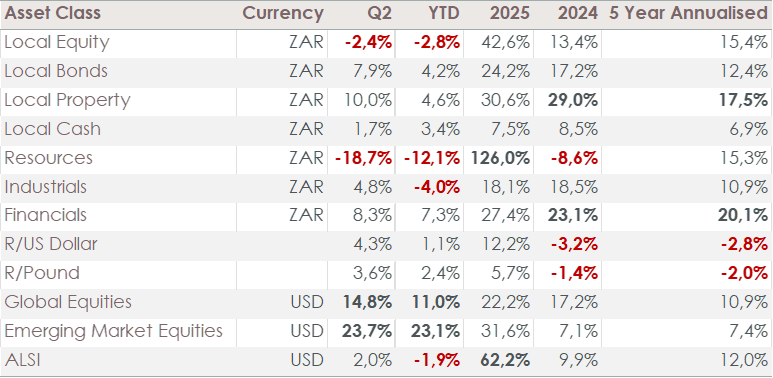
Source: PortfolioMetrix
What shaped global markets?
Geopolitics, commodities and monetary policy
The Middle East conflict was again a major theme of the quarter, but it cut both ways. Early on, escalating tensions drove oil prices sharply higher, stoking inflation fears across major economies. Toward quarter-end, the signing of a US-Iran Memorandum of Understanding sent Brent crude below US$80 per barrel.
The situation nonetheless remains fragile, with hostilities resuming after quarter-end and key shipping routes through the region are not yet fully secure.
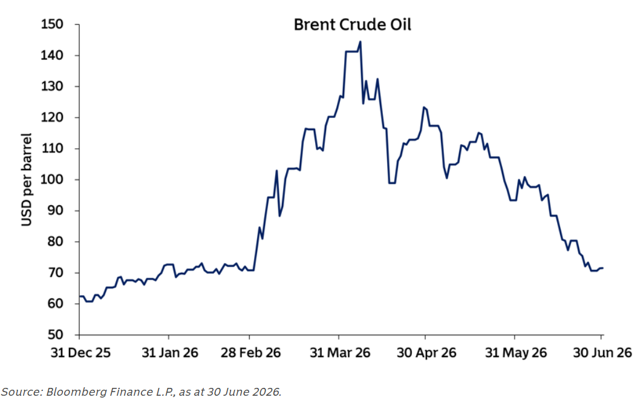
Source: Momentum (UK)
While oil prices have fallen meaningfully since the end of March, inflation remains sticky across most major economies, leaving central banks with little room to ease. The US Federal Reserve, under new Chair Kevin Warsh, signalled at its June meeting that rates would stay elevated for longer than markets had hoped. The European Central Bank and Bank of Japan went a step further and raised rates, while China moved in the opposite direction, cutting rates to support its slowing economy.
There has been a notable shift in monetary policy expectations since the beginning of the year. The images below illustrate this, with expected rate cuts shown in red and hikes in green, comparing expectations at the start of the year to where they stand now.
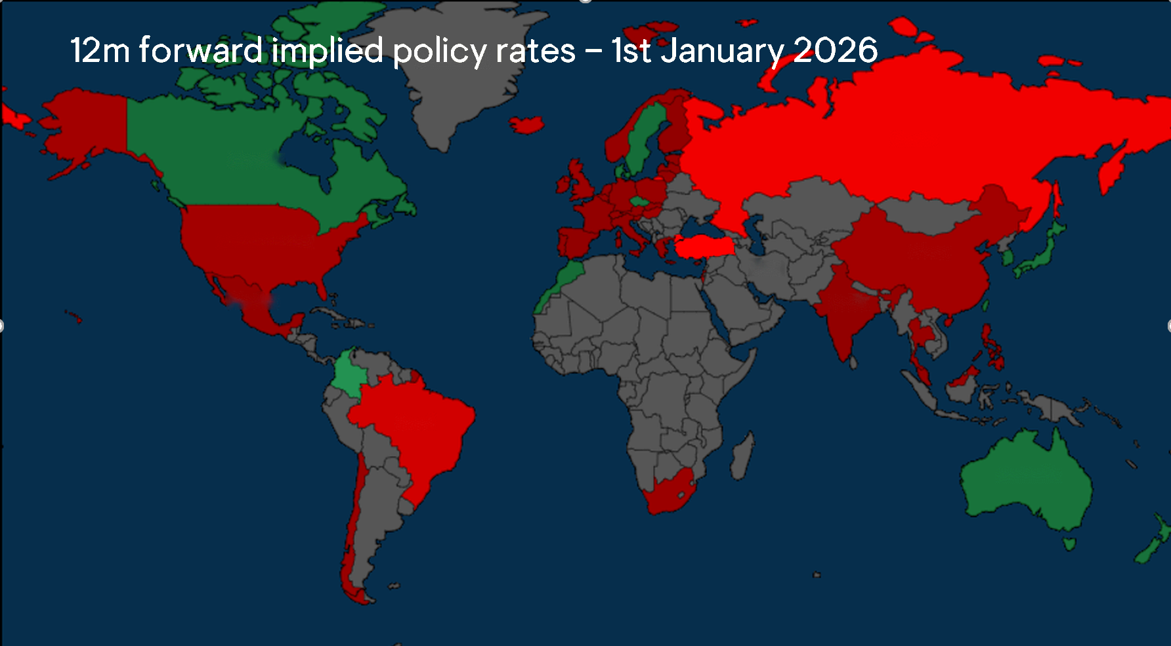
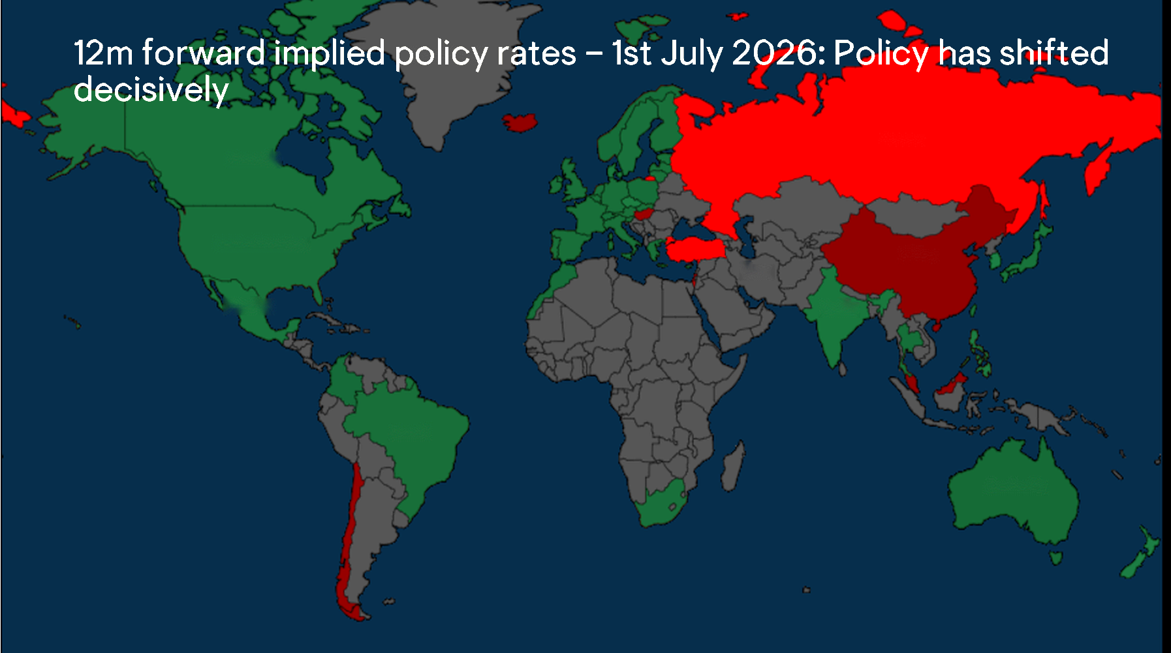
Source: NinetyOne
This shift toward higher rates, combined with a stronger US dollar and reduced demand for safe-haven assets, made gold and other precious metals considerably less attractive to investors. Gold dropped by 14,1% this quarter. On a 1-year basis, however, it is still up 22,5%.
Artificial intelligence & equity markets
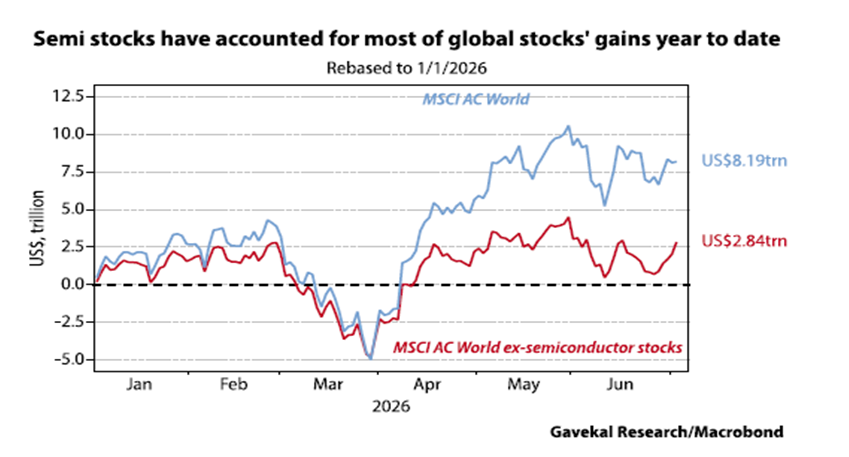
AI continued to drive returns over the quarter, but the source of those gains has shifted and remains narrow. The standout performers have not been the Magnificent Seven technology companies that dominated markets in recent years but their suppliers, the businesses providing the infrastructure that enables the AI race, rather than those running it.
Global equity market capitalisation has grown by roughly US$8 trillion this year, yet only US$2.84 trillion of that came from outside semiconductors. Hardware has proven more resilient than software.
Korea and Taiwan were the biggest winners and the reason for EM outperformance compared to DM.
Source: Morningstar
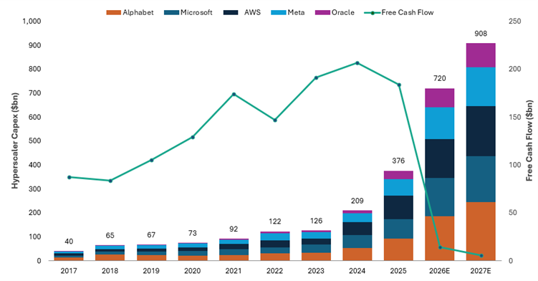
But this raises an important question. All this infrastructure spending ultimately depends on big technology companies continuing to invest at the current pace. Markets are beginning to ask whether future demand for AI products and services will justify the enormous sums being spent today. Any pullback in spending or a competition-driven fall in the cost of AI could yield a different outcome or winner.
Source: NinetyOne
The SpaceX listing on the Nasdaq was another marker of technology confidence, raising US$85 billion in the largest IPO the world has ever seen, valuing the company at US$2.1 trillion.
It is worth noting, however, that SpaceX reported losses of US$4.9 billion in 2025 and a further US$4.28 billion in the first quarter of 2026 alone.
Excitement around a company's potential and its current financial reality can be very different things. New listings like this don't enter global indices immediately; they work their way gradually over months as more shares become available to the market. Broadly diversified portfolios pick up exposure naturally over time, without the need to make a large bet on day one when prices are most uncertain.
What happened in South Africa?
South Africa had a quarter of two halves for most asset classes. Early on, rising oil prices and inflation concerns stemming from the Middle East conflict weighed on markets. As conditions stabilised toward quarter-end, geopolitical risks eased, and foreign buyers returned to bonds, property and the Rand. Equities were the exception, ending the quarter and year to date down 2,4% and 2,8% respectively.
Credit upgrades, foreign inflows and fiscal outperformance
The South African Reserve Bank raised the repo rate by 25 basis points to 7,0% in May, its first increase since 2023. This pre-emptive hike signalled a credible commitment to keeping inflation in check, with CPI rising to 4,5%, driven largely by fuel costs.
On the fiscal side, tax revenues came in better than expected at 8,4% above the prior year. Combined with sovereign credit rating upgrades from both Moody's and Fitch, this drew foreign investors back to South African assets. Bonds and listed property were the beneficiaries, returning 7,9% and 10,0% respectively. Even with a stronger dollar, the backdrop proved supportive for the rand.
SA equity & resources
The sector fell 18,7% as gold and platinum prices declined, dragging the broader index lower given mining's significant weight in the JSE. Strip out resources, and the picture is different. Financials gained 8,3%, with returns distributed across banks and insurers, and retailers recovered in June. The breadth of those gains, rather than being concentrated in one or two names, is an encouraging sign.
In addition, while equities struggled this quarter, the strength of and confidence in the bond market is an encouraging signal for South African equities going forward.
How did our portfolios perform?
Portfolios across risk profiles and geographies have performed well, exceeding the relevant benchmark averages.
The lower-risk profiles locally performed better over the quarter due to lower SA equity exposure and higher exposure to bonds. Returns across all the local portfolios ranged from 5,2% to 6% over the quarter. One-year returns ranged from 15,8% to16,9%.
On the global front, returns over the quarter, in USD, ranged from 9,5% to 16,4%. One-year returns ranged from 14,7% to 23,4%. In Rand terms, returns are lower due to the strengthening of the Rand.
What to keep an eye on
The key variables heading into the second half are inflation and interest rates, both of which will be shaped in large part by geopolitical developments. Inflation remains sticky across most major economies, and while falling oil prices offered some relief at quarter-end, the peace is fragile, and tensions have already flared up again.
Central banks, including the South African Reserve Bank, have signalled higher for longer, adding another layer of uncertainty to an already complex picture. On AI, the boom continues, but markets are beginning to question whether the scale of spending can be sustained and whether returns will justify it.
Given this backdrop, the case for a robust, strategically constructed portfolio is clear. One that is built for the long term rather than positioned around the next big theme because the discipline that keeps it out of the full weight of a winning story is the same discipline that keeps it out of the full weight of the losing ones. Over a full cycle, that balance is what matters most.
Read the full PortfolioMetrix quarterly local report here, and the full quarterly offshore report here.
<Foundation Family Wealth is an Authorised Financial Services Provider>