South Africans have a deep affinity for bricks and mortar to build and preserve wealth. Property therefore often comes up in our discussions with clients.
While property falls into what we consider the alternatives bucket - outside the traditional investment portfolio and not a replacement for a solid financial foundation - the decisions around how to own it have significant implications.
The right structure depends on the type of property and your intention for it. Changing ownership structures is difficult and costly, so it needs careful consideration.
Intention for property
Not all property is treated the same under South African tax law, and the type of property you own is the first thing that shapes your structure decision.
- Your primary residence is the home you live in. Your primary residence qualifies for a R2 million capital gains tax (CGT) exclusion when you sell - but only if owned in your personal name. In the context of property ownership, this is a valuable benefit.
- A holiday home sits between lifestyle and investment. It does not qualify for the primary residence exclusion. If it generates rental income, tax obligations follow. The more a holiday home functions as a business, the more the structure decision resembles an investment property decision.
- An investment property is bought for return - rental income, capital growth, or both. This is where structure matters most.
Regardless of property type, if the intention is for the property to stay in the family beyond your death and your children's lifetimes, tax is not the primary consideration - preserving the asset across generations is what matters most. That intention should determine the structure.
The four ownership structures
Personal capacity
Owning property in your own name is the simplest approach. You are in full control, there are no additional entities to maintain, and financing is straightforward.
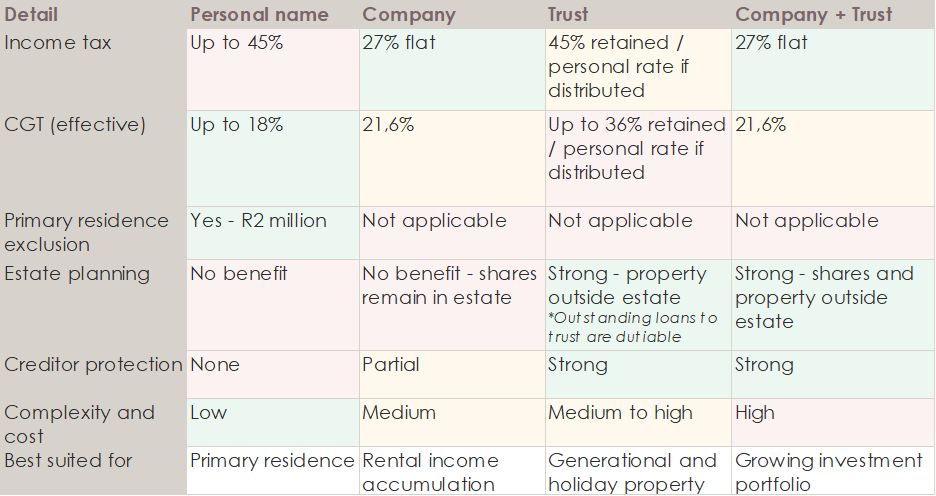
Property held in your personal name is subject to CGT when sold, at an effective rate of up to 18% on the gain. If the property is your primary residence, the R2 million exclusion applies.
Rental income is taxed at your personal marginal rate, which can be up to 45%.
On death, the full property value is included in your estate and attracts estate duty (20-25%), executor's fees (up to 4,025%), and a deemed CGT disposal. The estate winding-up process can be lengthy, which delays access for your beneficiaries.
As the property is a personal asset, it is also exposed to personal creditors. If you have financial difficulty, a creditor could have a legal claim over the property to recover what is owed.
Private company (Pty Ltd)
A private company is a separate legal entity that owns the property, with you holding shares in the company.
The main benefit is the flat corporate income tax rate of 27%, meaningfully lower than the top personal rate of 45%. This makes a company an efficient vehicle for accumulating rental income and reinvesting it. The CGT treatment is less favourable than personal ownership - the effective rate on gains is around 21,6% - but still manageable.
If you want to extract profits rather than reinvest them, Dividends Withholding Tax of 20% applies, pushing the effective combined rate to 41,6%. However, if the property was funded via a shareholder loan, you could repay capital rather than distribute profit, which means no Dividends Tax on the way back to you.
Shares in the company form part of your personal estate on death, so estate duty applies on their value even though the property is not in your name.
A company offers partial creditor protection. The property belongs to the company and cannot be directly claimed by your personal creditors. However, your shares in the company are a personal asset and could be attached.
Running a private company comes with ongoing costs, admin, and meetings.
Trust
A trust is a legal arrangement in which trustees hold assets for the benefit of named beneficiaries. The trust owns the property - not you - which means it falls outside your personal estate on death. There is no estate duty on trust assets, no executor's fees, and no delay in winding up. For property, like special holiday homes, intended to stay in the family across generations, this is the primary appeal.
Trusts also offer strong creditor protection. Because the assets belong to the trust and not to you personally, they are generally not accessible to your personal creditors.
However, by placing assets in trust you give up direct control. The trustees manage the property in accordance with the trust deed. Choosing trustees carefully and drafting a well-considered trust deed is therefore essential.
The tax costs are high if income is retained in trust. Trusts are taxed at 45% on retained income and CGT at an effective rate of 36%. Retaining rental income in the trust is not tax efficient. Income can be distributed to beneficiaries in the year it is earned, where it is taxed at their personal rates - but this requires active planning, suitable beneficiaries, and means the wealth accumulates in their personal names rather than in the trust.
A trust must be properly run. This means ongoing costs, regular meetings, and sound administration. If not, SARS or the courts can deem it a sham or alter ego trust and disregard the structure. The assets would then be treated as your own, and the benefits of the structure are lost.
Company owned by a trust
This combined structure brings together the strengths of both vehicles: the company provides tax efficiency on income, while the trust holds the shares and achieves the estate planning outcome. Rather than you personally owning shares in the company, the trust does. So, on your death, neither the property nor the shares form part of your personal estate.
It is the most administratively complex and expensive structure to run. It is best suited to a growing investment portfolio where the dual goals of tax-efficient accumulation and generational transfer both matter, and where the income and asset values justify the overhead.
Key considerations by ownership structure
Funding
Funding works differently depending on the structure you choose.
In your personal name, you can use accumulated capital or take out a bond. It is the simplest route and typically offers the best rates.
For a company or trust, you first need to get money into the entity. This is done either by donating to it or lending to it as a shareholder or founder loan.
If you donate, donation tax applies upfront at 20-25% depending on the value.
If you lend, loans to a company can be interest-free. Loans to a trust, however, must be charged interest at or above the official SARS rate under Section 7C of the Income Tax Act. If not, donations tax applies annually on the shortfall. Where a trust owns a company and holds at least 20% of the shares, this rule can extend to loans made to that company as well.
Any loan outstanding to an entity remains an asset in your estate until repaid, meaning estate duty is still payable on the loan amount.
Either entity can also take out a bond, often used alongside a loan or donation. Rental income rarely covers total costs in the early years, so the shortfall needs to be funded from personal income or additional loans to the entity. Banks will almost always require personal suretyship, which limits the creditor protection the structure would otherwise offer.
Conclusion
The structure you choose depends on your intention, how you plan to fund it and whether the size of the assets in the entity justifies the costs it entails. There are many aspects to weigh up, and priorities will be different for different people. These are big decisions, and we recommend involving a specialist before making any decisions.
At Foundation, we want to make sure you go into that conversation well informed, and act as a sounding board as you weigh the trade-offs against your broader financial picture.
<Foundation Family Wealth is an Authorised Financial Services provider>