

In my previous article, I wrote about where your retirement income will come from and described Foundation’s philosophy on retirement income planning.
This article asks the next question: how do you make sure that income lasts, especially given longevity and increased uncertainty?
Earlier this year, Jaco van Tonder, Advisor Services Director at Ninety One, published research on structuring retirement income. His team modelled thousands of market scenarios against South African pensioner mortality to identify what makes retirement income sustainable. His findings align closely with how we advise our clients, and he backs up every point with research.
It still surprises me how many retirement strategies in our industry rest on belief, anecdotal experience or the most recent data rather than research evidence based on long-term data. In addition, strategies often don’t account for current and future client experience or potential trends.
At Foundation, our retirement income planning philosophy carefully balances long-term evidence with current and potential future client experience. Our financial plans also include clients’ values, goals, and personal circumstances. Here are the five conditions we believe make a retirement strategy succeed
1. Draw a sustainable income
The income you draw is the most important decision you make in retirement. It is also the one you control most.
Ninety One’s research sets an income threshold for every age. If you draw above it, the risk that your income runs out during your lifetime rises sharply. The older you are, the more you can safely draw, because your capital needs to last fewer years. The chart below shows that for early retirees, a withdrawal rate closer to 5% is likely to ensure your capital lasts, while withdrawal rates of around 9% are sustainable from the mid-eighties.onsideration – preserving the asset across generations is what matters most. That intention should determine the structure.
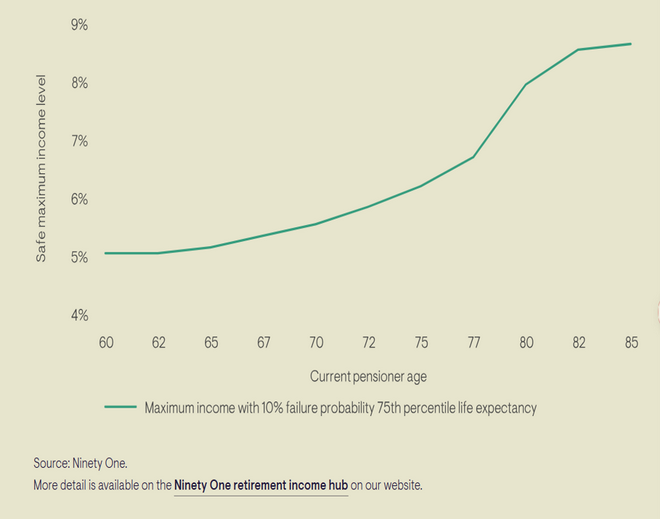
We monitor the overall withdrawal rate from the portfolio over time – not just from the living annuity. When you fund a new car, an overseas trip or a provisional tax payment from your non-retirement pool, you take pressure off your living annuity. A well-funded accessible pool from the day you retire keeps your draw rate on your living annuity in the safe zone for longer.
In some instances, it may make sense to have different withdrawal rates on the different pools of capital for estate planning or tax planning purposes. For example, if it makes sense for children living abroad to inherit from the global portfolio, you could increase the withdrawal rate on the local investments. Alternatively, it may make more sense to have a low living annuity withdrawal rate and increase the rate on the other assets to lower the overall tax burden.
2. Hold enough growth assets
Inflation is the biggest risk you face in retirement, and the one most people underestimate. Because it compounds, small errors become large losses over time.
I lived through years of high inflation early on in my career. We can’t assume this will never happen again. Inflation moves in long cycles of a decade or more. Over a 30-year retirement, you will probably live through at least one. Although sustained strict monetary policy has probably reduced the risk of an inflation blow-out in South Africa, this year showed how quickly the outlook can change. The war between the USA and Iran pushed oil prices up sharply, and inflation rose from 3.5% early in the year to 5% by June.
Growth assets such as equities and property protect your portfolio against inflation risk. Ninety One’s research shows that a living annuity needs at least 60% in growth assets at a typical income level. This contrasts with the belief that retirees should lower growth assets to limit risk.
But what if you have more than enough capital? One of our clients asked exactly this: does a balanced portfolio make sense when there is more than enough money in the overall retirement plan?
The lower your income draw, the lower the minimum equity exposure you need. You can always choose more equity, because living annuities benefit from growth. However, a cap of around 75% in growth assets is sensible given that withdrawal is mandatory. An adviser who recommends 90% equity in a living annuity may face questions about the appropriateness of that advice, even though the maths supports higher equity.
The right allocation is the one your plan needs, not the maximum risk your plan can bear. If you draw a low income, you can choose a calmer portfolio and still reach your goals. If you draw a higher income, you can balance growth with less volatility.
3. Balance local and offshore
Ninety One’s research shows that a living annuity works best with 25% to 55% invested offshore, regardless of your income level. Above 60%, the risk of failure rises sharply, especially at higher withdrawal rates. Very high offshore exposure only makes sense if you plan to emigrate or already live abroad, and your future expenses will be in foreign currency.
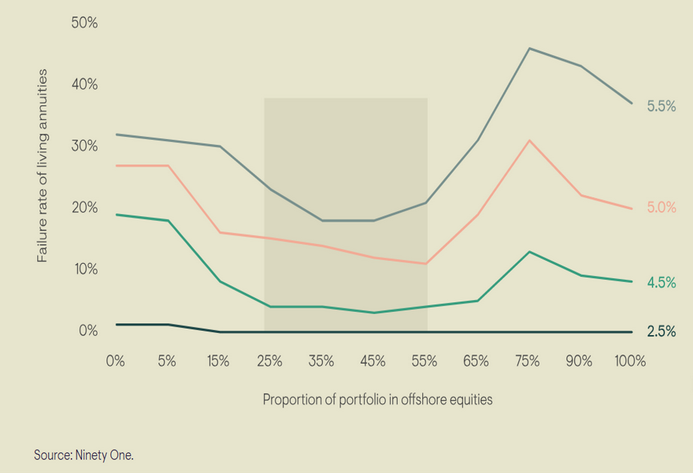
This challenges a popular strategy. Many investors have moved most of their retirement capital offshore in recent years. If you live and spend your retirement in South Africa, that strategy may increase your risk rather than reduce it. You may cover political risk but expose your retirement capital to another equally dangerous risk – currency volatility.
As I wrote in my previous article, offshore is not a separate kingdom. It is part of your integrated retirement pool. We set your offshore exposure across your whole household. We look at your living annuity, your discretionary offshore investments and the expenses you expect in foreign currency, such as travel, supporting children who study or live abroad or even big-ticket items like cars, which are often imported.
Although we are averse to very high global exposure for retirees in living annuities, the inverse is also true. When a retiree’s portfolio lacks enough global exposure, it can also increase the probability of running out of money. The sweet spot seems to be somewhere between 25% and 55%. Global exposure benefits portfolios by increasing diversification, which limits portfolio volatility. In addition, the South African market has shrunk, and global markets now provide opportunities not available in the local market.
4. Manage volatility, don’t chase returns
Retirement changes the rules of investing. While you build wealth, a market fall is an opportunity to buy at lower prices. Once you draw an income, a market fall may become a threat. If markets drop sharply early in your retirement, you sell assets at low prices to fund your income. That capital may never get the chance to recover.
This is why success in retirement depends less on maximising returns and more on managing volatility. A portfolio built for the real return your plan needs, with as little volatility as possible, gives your capital the best chance of lasting.
We wanted to make this research relevant to our clients. PortfolioMetrix (PMX), our investment partners, who manage most of our retirees’ investments, extended the analysis using their portfolios.
PMX builds portfolios to manage risk as well as return. Across different withdrawal rates, the portfolios followed a smoother path, which matters most when you draw an income every month.
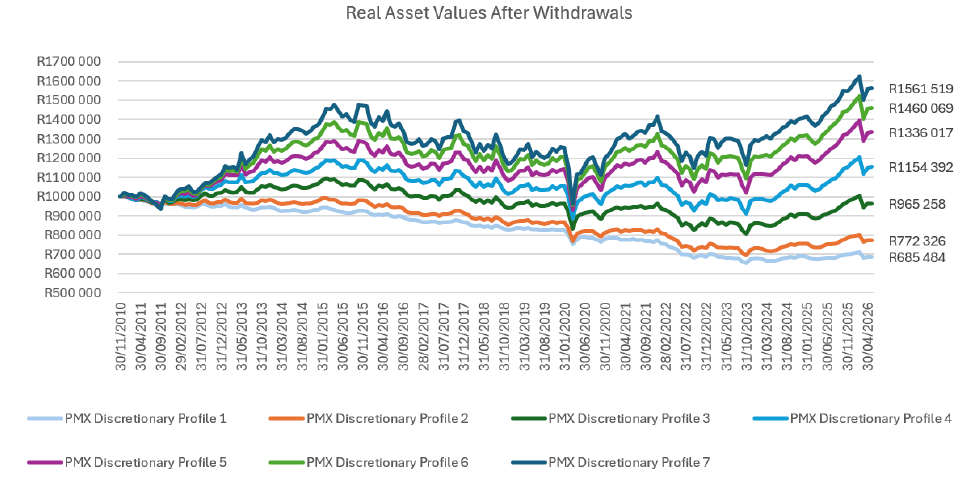
Although past performance is not a guarantee of future performance, it is also good to notice that PMX’s focus on volatility resulted in better outcomes for clients since its inception. The graph below shows results for portfolios with high equity exposure, but results were similar for medium-equity portfolios.
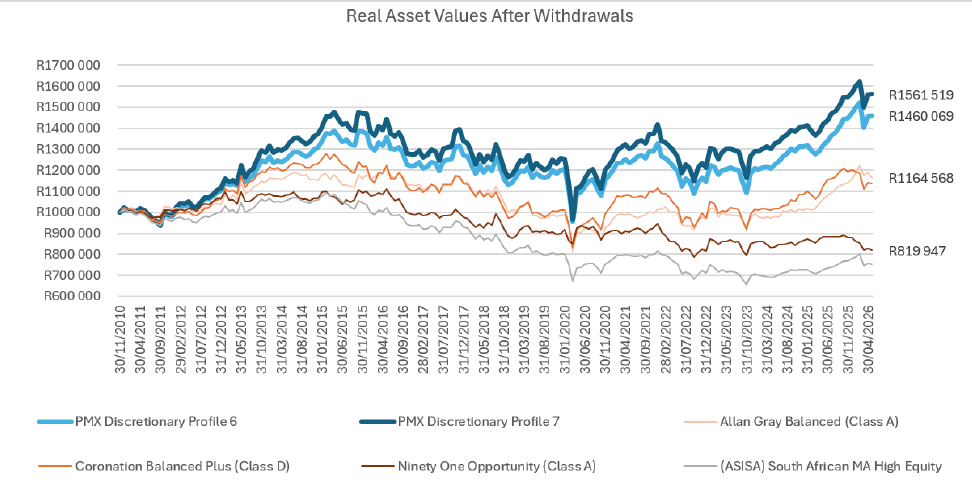
A calmer portfolio also has a behavioural benefit. It is easier to stay the course when the headlines are frightening. We believe that it is part of our responsibility to choose investment partners who construct portfolios that make it easier for our clients to stick to their financial plans. Keeping you on track through the noise is one of the most valuable things we do for our clients in the long run.
5. Keep your options open
Since the start of Foundation, I’ve believed one of the biggest trends in financial planning would be increasing life complexity. People were living longer. Jobs were becoming less secure. Divorce was a more common occurrence. Some retirees started second careers. Others face health setbacks or the loss of a partner.
The responsibility for financial independence was shifting from employers and the state to the individual.
Over the decades of retirement, your health, your family, and the markets will change in ways you cannot predict.
We are also seeing a growing need among our clients to support extended family members during retirement. Parents live longer and need care. Adult children face a harder economy and need help with a deposit or school fees. Siblings run into difficulty. This need is often unexpected, and it rarely fits neatly into the initial retirement budget.
That is why optionality has real value in retirement.
In your living annuity, you can adjust your income once a year, anywhere between 2,5% and 17,5% of your capital. You can change your underlying investments as your needs change. You can also convert part or all your living annuity to a guaranteed annuity later, but you can never reverse that decision. If you split your retirement capital across more than one living annuity, you can make that decision in stages as your health, family and markets evolve. Although a guaranteed annuity may suit clients with limited resources and a preference for certainty, it limits flexibility and often doesn’t offer enough inflation protection.
Outside your living annuity, your local and offshore investments give you access to capital when life surprises you. You can help a parent with care costs, support a child or fund a medical expense without raising your living annuity draw or locking yourself into a decision too early.
Balancing these changing requirements and the different risks in your portfolio over time is a combination of skill and art. It asks us, as financial planners, to hold together increasing complexity, difficult trade-offs, and a family’s specific needs. It requires interpersonal skills to manage the conversations that require difficult decisions.
Retirement is not a single decision at 65. It is a series of decisions over decades. The research gives us the conditions for success, but applying them to your life takes an ongoing relationship with a financial planner who knows you and your family. That is the financial partnership we set out to build.
If you would like to talk about how your retirement strategy measures up against these five conditions, please get in touch.
Foundation Family Wealth (Pty) Ltd is an Authorised Financial Services Provider. The PMX simulations use historical performance and are for illustration only. Past performance is not a reliable indicator of future results.