

Money is a funny thing. It plays such a big part in our daily lives, yet we’re so uncomfortable talking about it. Even with our partners.
Maybe that’s because money is rarely just about money. For one person, it means security. For another, freedom. Some see spending as a reward for hard work. Others feel physically uncomfortable spending at all. One wants to enjoy life today; the other worries about having enough later. Neither is wrong. But put these two people in a relationship, and you have the makings of some interesting disagreements.
You didn’t arrive in your relationship alone. You brought your family’s relationship with money with you.
It’s like carrying an invisible backpack. It holds all our childhood beliefs and experiences, including those about money. How our parents managed it. Whether we grew up with plenty or very little. What we learnt about debt, generosity, success and independence. Maybe money was a constant worry in your home, or maybe you never discussed it. Maybe you grew up believing the man should provide, or that success should be visible. You carry this backpack everywhere. Some of us carry big, bulging ones.
Because these beliefs run so deep, we rarely question them. We simply assume our way is the right way. Then we fall in love with someone who sees things completely differently.
No wonder money causes friction. A 2012 study published in Family Relations found that arguments about money predicted divorce more strongly than other common marital disagreements.
Whose money is it anyway?

When two people build a life together, they have to decide how to organise their money.
A 2023 study published in the Journal of Consumer Research randomly assigned engaged and newlywed couples to combine their finances, keep them separate or make no changes. Two years later, the couples who combined their money had stronger relationships than the other groups.
I don’t think combining finances is a golden rule. But I do think it says something about teamwork. It’s no longer my salary paying for your expenses. It’s our income funding our life together.
Then there’s the question of who controls the money. Earning it, running the household and making the long-term decisions are three very different things. They’re not always done by the same person.
According to Pew Research Center, in 45% of American opposite-sex marriages, women now earn as much as or more than their husbands. In the 1970s, it was less than 30%.
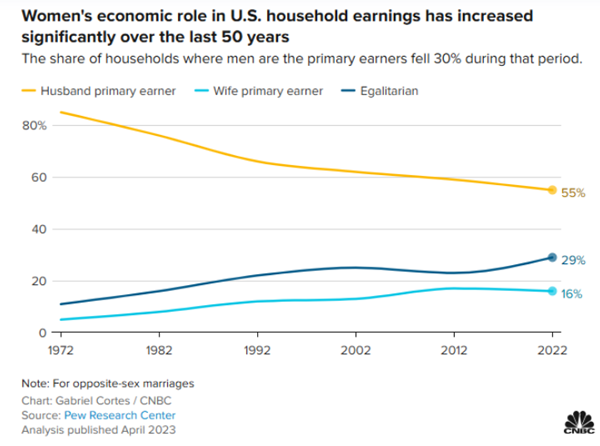
Yet a UBS survey of affluent couples found that only 20% shared long-term financial decisions equally. Influence and decision-making, therefore, have not kept track with earnings growth.
I find this interesting because I see versions of it in my work. In many households, one person manages the day-to-day spending and keeps the family running. The other makes the decisions about investments, retirement and long-term wealth. Often this has happened naturally over many years, and both are comfortable with it.
It’s fine to hand responsibilities to your partner if it feels fair to both of you. But delegating and disengaging are different. When you delegate, you don’t need to understand every investment, but you should know what there is and whether it’s enough. Disengaging is the ‘head in the sand’ approach. You don’t really know what you have, how it’s invested or what the plan is. I think disengagement is problematic. Life changes. People get sick, relationships end, and partners pass away. Knowing what you have is a form of protection.
What does fair mean?
Imagine a couple who’ve been married for 25 years. They’ve raised children, built a home and always treated their money as shared. Then one of them inherits R10 million.
Whose money is it?
Now imagine the inheritance stays invested in that partner’s name, while the other keeps paying most of the household expenses. Ten years later, one has built up significant personal wealth. The other has funded much of their daily life. Is that fair?
I suspect your answer depends on which side you’re on. And that’s the point. What belongs to someone legally, what feels fair and what two people think they agreed to aren’t always the same thing.
Or take a couple where one partner earns a lot more, while the other took time out of their career to raise the children. Should the higher earner have more say over how the money is spent? How do you value the unpaid work that made the other person’s career possible?
We like to think fairness means splitting expenses equally, or in proportion to income. But relationships are rarely that simple. Money is only one part of what people bring to a partnership. And equal contributions don’t always mean equal sacrifices.
What feels fair at 30 may also look very different at 50 or 70. Children arrive. Careers change. Someone gets ill. An inheritance shifts the balance. One partner retires before the other. Life changes the rules long after we’ve agreed to them.
The things we don’t say
Turns out we’re not always honest with each other about money. A 2025 Bankrate survey found that 40% of married or cohabiting Americans admitted to some form of financial secrecy.

Maybe you bought something and fibbed a little about the price. Or didn’t mention a credit card balance because you knew it would start an argument. I suspect the secrecy is often less about deceiving and more about avoiding a fight. But once something is deliberately hidden, it’s no longer just about the money. It’s about trust.
Privacy and secrecy are also different. Having your own money to spend without accounting for every cent is perfectly reasonable. Hiding debt or big purchases that affect your shared future is something else. But what about a secret savings account?
Maybe someone is putting money aside because they don’t feel secure or independent in the relationship. In a controlling relationship, that money might even be necessary. The same behaviour can have very different reasons. So before judging, it’s worth asking why. You’re far more likely to have a good conversation that way than through blame or shame.
Maybe we need to talk more about money, and less about the numbers
As financial planners, we spend a lot of time helping people work out what they can afford, how much they need and how to structure their wealth. But I’ve come to believe that some of the most important money conversations have very little to do with investments.
They’re about what money means to each person, what they expect from each other and what makes them feel safe. Having an independent person in the room can help couples talk through different priorities, question assumptions and make decisions together. A 2025 CFP Board study found that 42% of clients working with CFP® professionals reported fewer financial conflicts at home. That doesn’t prove the planning caused it. But it does suggest good advice is about more than investment returns.
I don’t believe there’s one right way for couples to manage money. Every relationship is different. But I’ve realised these three things matter:
- Fairness. What feels fair to you may be very different from what feels fair to your partner. It doesn’t mean contributing equally, earning the same or having the same responsibilities. What matters is that you both feel the arrangement is fair, and neither feels taken for granted.
- Trust. Especially when one partner manages most of the money. The other needs to feel confident that decisions are made with both of your interests at heart. Trust isn’t handing over control blindly. It needs openness and enough shared understanding for you both to feel secure.
- Communication. Probably the hardest of the three. We all bring our own experiences, beliefs and emotions about money into a relationship (remember that backpack!). Being able to talk about what matters to us, where our fears come from and why we see things differently, without judgement or blame, is essential.
You don’t have to agree on every money decision. You just need a way to manage money where you both feel heard, respected, and secure.
<Foundation Family Wealth is an Authorised Financial Services Provider>