
Look
Same valuation. Different story.
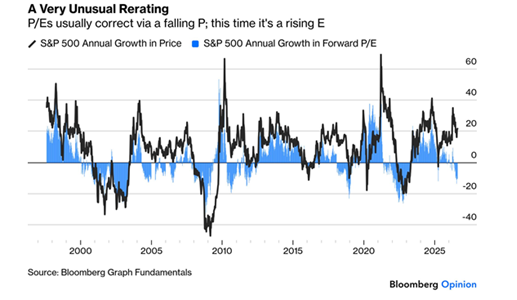
A price-to-earnings ratio, or PE ratio, is simply what investors are paying for a share relative to the profits behind it. When I wrote about US markets in March 2024, the S&P 500 was trading at just over 20 times expected earnings, and I thought it looked expensive.
Source: Bloomberg
At the time, share prices had risen much faster than expected earnings, pushing valuations and the PE ratio higher. Two and a half years, and two very good years for investors later, we are sitting at roughly the same valuation. But this time earnings have been growing faster than share prices. Instead of valuations corrected through falling prices, profits have increased.
Source: Bloomberg
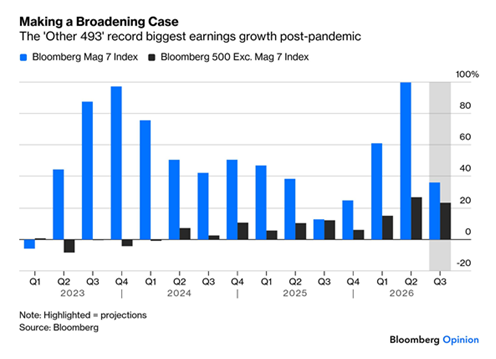
The second graph adds another interesting shift. For the last few years, earnings growth has been dominated by the large technology companies. This is now broadening, with the other 493 companies in the S&P 500 producing their strongest earnings growth since 2021. Some of this is being fueled by the enormous amounts being spent on AI. Spending money on chips, data centres, electricity and infrastructure becomes revenue for companies across the broader economy.
So, strangely, we find ourselves in much the same place as we did in 2024, but for quite different reasons. Same PE, stronger and broader earnings. The question is how sustainable this growth is, particularly when so much investment is linked to the AI boom. We remain cautious, but it is also a useful reminder that one number can tell us surprisingly little about what markets will do next.
Listen
Wealth = what you have – what you want
I’ve shared Morgan Housel in this letter before, and because he is simply the best money storyteller, I’m sharing it again!
Earlier this year, he released a new book called The Art of Spending Money. Most personal finance writing is about how to earn it, save it and grow it. This one is about the harder part. What to do with it once you have it.
One of his quotes is so powerful, and if it’s the only thing you remember, I urge you to remember this:
Wealth is simply what you have, less what you want.
You see, many people derail their financial freedom by wanting more or spending too much on lifestyle. You earn more, so you spend more, and so the cycle goes. But what happens if you want less?
The lessons are powerful, and so is this conversation with Shane Parrish on The Knowledge Project.
Here are some of the small takeaways from the conversation:
- Money buys fewer bad days, not more great days.
- Contrast drives happiness, not absolute levels. There was a time when you wanted exactly what you have now.
- Optimise for sleeping at night, not for maximising a spreadsheet.
- Every rand you save is a step towards independence. Saving is buying freedom, not going without.
- 99% of Warren Buffett’s net worth was built after his 65th birthday. That’s just how compounding works.
- Give your children money when they need it, in their thirties. Not when they’re 75, and you’re long gone.
- The biggest financial mistake you’ll make has nothing to do with money. Therefore, often mitigated by good financial advice.
Learn
It’s not caution. It’s confidence.
According to Discovery, South African women retire with 21% less than men. I wasn’t surprised. The reasons are well documented: the pay gap, career breaks and the fact that women still tend to carry more of the responsibility for caring for children and family.
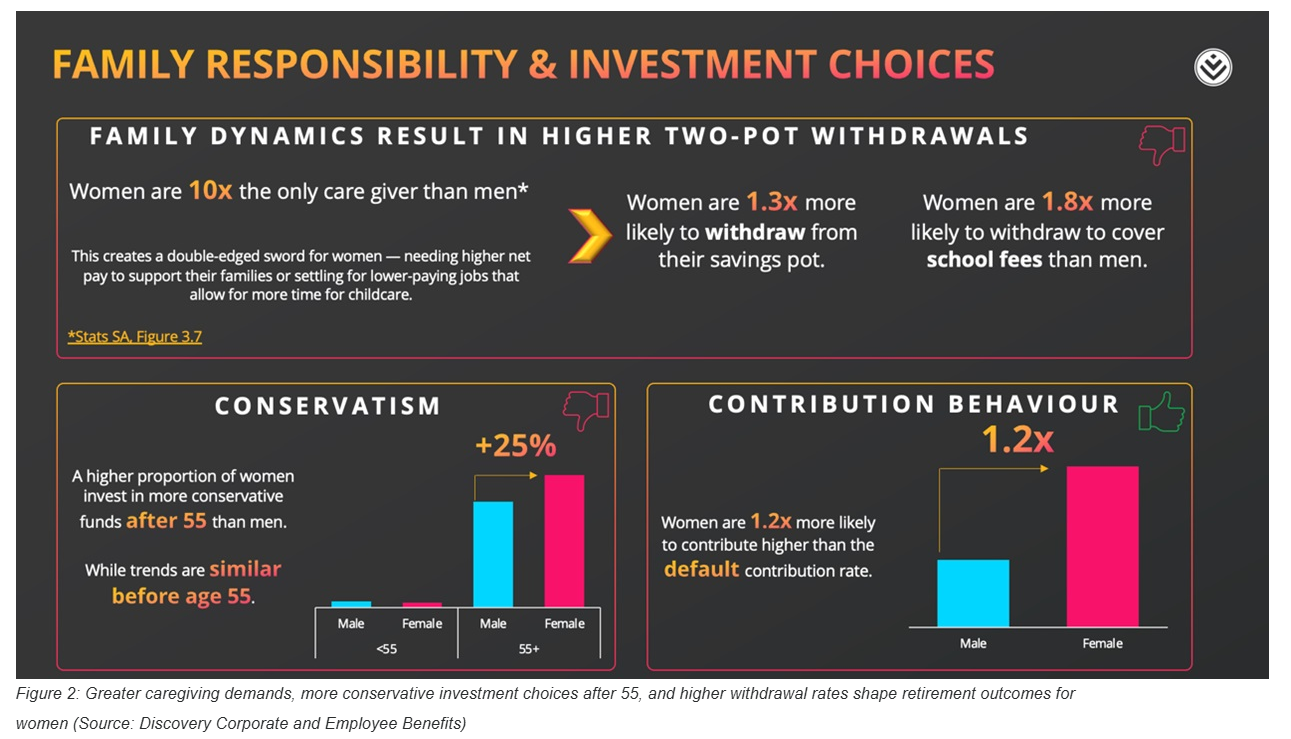
What interested me was the behaviour underneath the numbers. From age 55, women are 25% more likely than men to be invested conservatively. Under the two-pot system, they are 1.3 times more likely to dip into their retirement savings, and 80% more likely to use that money for school fees. Yet women are also 1.2 times more likely to contribute above their employer’s default savings rate. So, this gap isn’t simply a story about women saving less.
I think two different things are happening. The first is confidence. In my experience, when women are unsure about an investment decision, they tend to choose the safer option. That makes sense. But when they understand their objectives and feel confident in their financial decisions, I don’t see the same reluctance to take investment risk.
I went looking to see whether the research supported this, and it does. A study called Fearless Woman, by Tabea Bucher-Koenen and colleagues, including Annamaria Lusardi, found that around a third of the gender gap in financial knowledge could be explained by differences in confidence rather than actual knowledge. Put simply, women often know more than they think they know.
The second behaviour is different. Women seem more willing to spend their money on others, particularly children and grandchildren. I see this regularly in practice. The school fee statistic is a good example. I don’t necessarily think this is poor financial behaviour. Money is there to be used, and helping your children may be one of the things you most want to do with it. The question is whether you can afford to.
Perhaps the answer isn’t that women need to invest or spend more like men. Good financial planning should give women enough confidence to take the investment risk they can afford, and enough clarity to spend generously on the people and things that matter to them without jeopardising their own financial security.
Ponder
In this section, I invite you to think about a question I may pose or a thought I may share.
“Wealth is what you have less what you want.”
Morgan Housel
Oenophilia
“Oenophilia simply refers to enjoying wine, often by laymen.”
I love Chardonnay when the seasons change. It’s not quite summer, although we’re all in a hurry to get there, and something not too full and not too light feels just right.
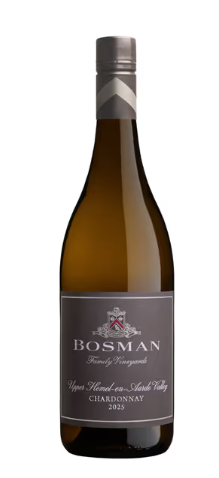
This month’s pick is the Bosman Upper Hemel-en-Aarde Valley Chardonnay. Bosman has been growing vines for eight generations and has a fascinating history. In 2008, 260 permanent workers received a 26% stake in the business through the Adama Apollo Workers Trust, in what Bosman says remains the largest land reform transaction in the history of the South African wine industry.
The wine itself is fresh and elegant, with citrus, almonds and a lovely mineral finish. Just right for an afternoon that hasn’t quite committed to summer yet.
Stay curious,
Elke Zeki