
Look
Looking at property through a global lens
This chart caught my attention! It compares house prices to incomes around the world.
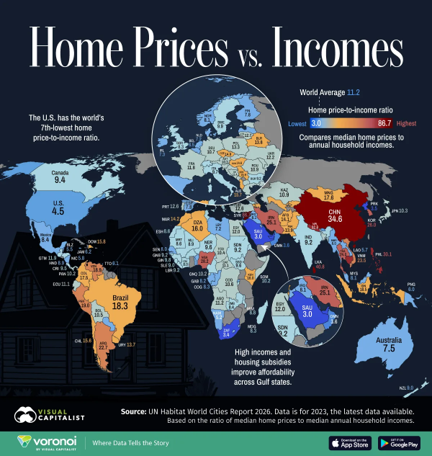
Source: Visualcapitalist
At first glance, South Africa appears remarkably affordable. Relative to many developed countries, our property prices still look reasonable, suggesting we can get more for our money than someone in Europe or North America.
But as I looked at it, I couldn't help thinking that this doesn't quite reflect what many of our Western Cape clients are experiencing. In fact, we've had several conversations recently with families who feel priced out of the Cape Town market, and even some who have chosen to move back to Johannesburg because housing has simply become too expensive.
I suspect the explanation is that parts of Cape Town are no longer being priced purely by South African buyers. While foreign purchasers still account for only a small percentage of property transactions nationally, their presence is much more significant in the luxury market, particularly in suburbs along the Atlantic Seaboard and other sought-after areas. That's important because these buyers aren't comparing Cape Town prices to South African incomes; they're comparing them to London, Amsterdam, southern Spain and Italy! Through that lens, Cape Town can still look remarkably good value.
Luxury property is probably less income than wealth. Buyers at this end of the market are typically purchasing with accumulated assets rather than annual salaries, which makes a simple price-to-income comparison less meaningful.
Whether this trend will continue is an interesting question. Cape Town continues to offer a wonderful lifestyle, a relatively weak currency and prime property at good global prices. But there are risks! A stronger rand, changing visa policies, political uncertainty or shifts in global investor sentiment could all influence demand. I just thought this graph was a reminder that the South African property market is not one market, but it’s somewhat divided with different driving forces and risks to consider.
Listen
What happens when you give people more than they expect?
I've been listening to Oprah's conversation with Will Guidara, world-famous restaurateur and author of Unreasonable Hospitality. This interview stayed with me, first because of Will’s beautiful storytelling, but also because ultimately his book is not about restaurants or hospitality; it's really about people, generosity, resilience, and leading with intention.
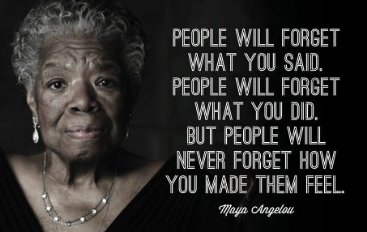
Guidara says that people may not remember every detail of what you did for them, but they will remember how you made them feel. It reminded me of Maya Angelou's famous quote: "People will forget what you said. People will forget what you did. But people will never forget how you made them feel."
Whether you're leading a team, raising children, servicing clients or simply trying to leave the world a little better than you found it, there's something here worth reflecting on.
Learn
What disappears when our books disappear?
Last December we rented a small wooden cabin in Nature's Valley. It wasn't fancy, but it had one feature that captivated me: an enormous bookshelf. Shelf after shelf was filled with books. I read many titles, including many I'd always wanted to read. I must have spent hours standing in front of it, pulling books out, reading the covers and debating what to choose. In the end, I put my Kindle away and picked up a book from the shelf: A Brief History of Seven Killings by Marlon James. It took me days to decide!
Interestingly, every member of our family did the same. We talked about books over dinner, recommended titles to one another and, before we left, the owners told us we were welcome to take any unfinished books home. We didn't. Instead, we ordered them on Takealot, so they'd be waiting for us when we got back home.
I've been wondering ever since why that experience stayed with me, and this article resonated so much.
It wasn't simply about reading on paper again after almost a decade of reading almost exclusively on my Kindle. It was what those shelves quietly communicated. It somehow told me about the owners of this property. People I have never met, yet I felt I knew something about them. Their books told me what interested them, what had shaped them, what they valued. Their library wasn't just decoration; it felt like a window into who they were.
And then I realised something else. After ten years of digital reading, I had read so many wonderful books... yet if you walked into my home, you wouldn't know it. Nothing reflected that part of my life.
Research suggests people often focus better and remember more when they read physical books, but I suspect that's only part of the story. The author quotes linguist Naomi Baron, who argues that tangible objects hold a value that screens cannot replace. Books are discovered by browsing a friend's shelf or a bookshop. They can be lent, gifted, inherited and displayed. They become part of our story.
Don't get me wrong, I still love my Kindle. It makes travelling much easier and has introduced me to many authors I might never otherwise have discovered. I suspect I'll always have one. But since last December's holiday, I've found myself buying paper books again. Not all of them. The ones I'll recommend, reread, lend to a friend, or hope my children stumble across one day.
Somewhere along the way, reading stopped being just about consuming ideas. It became about surrounding myself with them. Building a home that reflects the books that have shaped me.
The only problem? I have a feeling I'm going to need a much bigger bookshelf.
Ponder
In this section, I invite you to think about a question I may pose or a thought I may share.
Oenophilia
“Oenophilia simply refers to enjoying wine, often by laymen.”
A client recently gave me this wine, and I'm almost embarrassed to admit it; despite considering myself something of a wine enthusiast, I'd never heard of Kershaw. After reading more about Richard Kershaw and tasting the wine, I immediately regretted opening it so soon! I've since added a few bottles to my cellar to see how they evolve over the next few years.
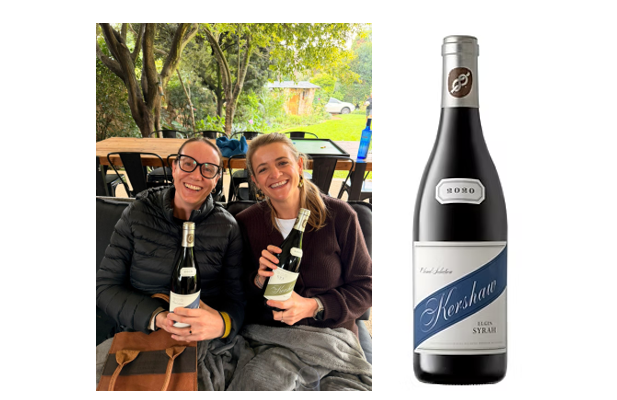
This month's pick is the Kershaw Elgin Syrah. Richard Kershaw is one of only a handful of Masters of Wine who also makes wine. His philosophy is beautifully simple: identify exceptional vineyard sites, match them with the most suitable grape clones, and allow the unique character of Elgin to shine through. South Africa's coolest wine-growing region provides the long, slow ripening season needed to produce wines of elegance, freshness and precision.
The result is one of South Africa's finest expressions of Syrah. Expect aromas of blackberries, black pepper and spice. If you enjoy Syrah, this is worth seeking out. Perfect alongside hearty winter soups, stews or a roast lamb.
Stay curious,
Elke Zeki