Look
The energy crisis is more of a threat to developing economies
It has been more than a month since Iran effectively closed the Strait of Hormuz. A narrow waterway through which about a fifth of the world’s traded oil passes every single day. The global economy is starting to feel stressed. But it is not feeling it equally.
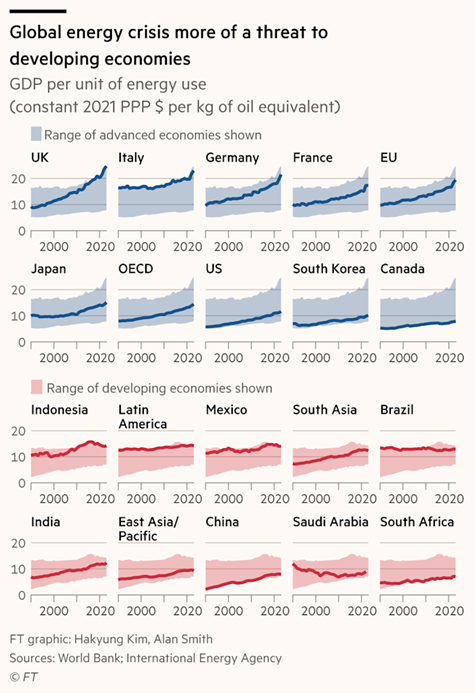
This chart from the Financial Times cuts to the heart of why. It measures GDP per unit of energy used. i.e., how much economic output each country produces for every kilogram of oil equivalent it consumes. Think of it as energy efficiency at a national level. And the gap between the two groups it reveals is striking.
Source: Financial Times · World Bank · International Energy Agency
Since 1990, advanced economies have made dramatic gains in energy efficiency by producing significantly more output per unit of energy consumed. The UK, Germany, France, the EU: all trending sharply upward. Developing economies, by contrast, have largely stagnated. And South Africa sits clearly in that second group.
The structural reason is important. Manufacturing-heavy economies are inherently more energy-intensive than services-driven ones. When the UK shifted toward financial services and technology, it became far less energy-dependent per pound of output. Most developing nations that are still heavily reliant on manufacturing, agriculture and basic industry have not been able to make that transition. Their exposure to an oil shock is therefore not just financial; it is woven into the fabric of how their economies produce things.
The knock-on effects extend beyond the petrol price. Oil and gas are the inputs needed for fertiliser production, sulphur production, and plastic manufacturing. All three risk falling to critical lows globally amid the shipping disruptions. For lower-income countries like South Africa, the consequences could be severe. We will feel it in the rand, in fuel prices, in the cost of running a business, and eventually in the cost of living.
Listen
Why two-income households are still not enough
I enjoyed this candid talk by Dr Eliza Filby, as I know so many will resonate with this tightrope.
We’ve come to see the two-income household as a symbol of progress compared to the 80’s. More opportunity, more independence, more equality. And in many ways, it is. But there’s another side to the story. What used to be a choice has quietly become a requirement.
In the 1980s, one stable income could often support a home, raise children, and still leave room for savings or small luxuries. Today, the same life typically requires two. Not because families have become more demanding, but because the high, non-negotiable costs such as housing, childcare and education have risen far faster than wages. So, two incomes no longer get you ahead; they merely help you keep up.
What makes this feel so different, though, isn’t just the money but also the pressure on time. We’ve expanded the workforce so both parents can work, but we haven’t rebuilt the systems around it. Workplaces, school hours, and care structures still assume someone is at home, even when both parents are working. The result is a life that runs at full capacity!
Many households today don’t feel poor in the traditional sense, but they feel stretched, time-poor, and constantly balancing competing demands. What looks like progress on the surface has, for many, become a more fragile and demanding way to live.
Learn
Crisis-fighting in a more fragile world
Christine Lagarde, president of the European Central Bank, speaks with The Economist’s editor-in-chief, Zanny Minton Beddoes, about what it means to manage crises today and why it has become meaningfully harder.
Her message is calm but sobering. Global markets may be underestimating the impact of the current energy shock. Disruptions linked to the Iran conflict could last longer than expected, with consequences that unfold gradually rather than all at once.
What stands out is not just the shock itself, but the environment around it. We live in a time with less global coordination, more political pressure, and fewer easy policy tools. Central banks are being asked to balance inflation and growth with no clean answers.
For me, the main takeaway is that we are not just dealing with another crisis, but also operating in a world where crises are more complex, more political, and harder to contain.
From a financial planning point of view, ways to ensure you can withstand this kind of uncertainty are to ensure your investments are suitably diversified and that you have enough liquidity available.
This was a thought-provoking interview, summarised here on YouTube. For subscribers to The Economist, I highly recommend watching the entire interview.
Ponder
In this section, I invite you to think about a question I may pose or a thought I may share.
“It’s not greed that drives the world, but envy.” Charlie Munger
Oenophilia
“Oenophilia simply refers to enjoying wine, often by laymen.”
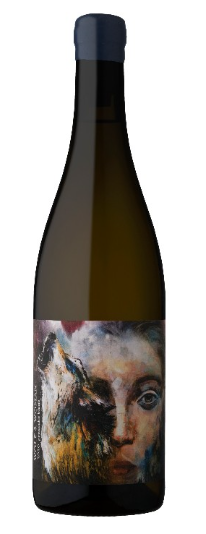
There are wines you find, and wines that find you. Wolf and Woman Wines feel like the latter. It was recently introduced to me by a friend and fellow wine lover from the UK. I have never heard of this small Swartland producer. Their wines are rooted in thoughtful farming and have a strong sense of place.
Their Grenache Blanc is my pick for the month. It's expressive, textured, and quietly complex, with notes of stone fruit, citrus and a fresh line of acidity.
It’s autumn in Swartland, the vines are changing colour. Pour this slowly, pair it with something simple, and let it tell you its story!
Stay curious,
Elke Zeki