
In my previous article, I wrote about how an access bond can be a useful place to hold your emergency fund. This is the next piece in a property series, tackling a question we’re often asked and one widely debated: should you pay only the minimum on your bond and invest the surplus, or focus on paying down the bond faster?
We assume the basics are in place. You have an emergency fund in your access bond, adequate insurance, and no short-term, expensive debt.
This discussion relates to your primary residence, not investment property. So, the question is what to do with surplus cash beyond that?
What the narrative gets right - and what it misses
The prevailing view is that investing your surplus is the obvious choice. The logic is simple: equity markets have historically delivered returns above home loan interest rates, and keeping all your wealth in a single property concentrates rather than diversifies risk.
These points are valid; however, they are only part of the picture.
What this view does not consider is your personal circumstance, preferences and the value of having fewer obligations. The focus is purely on the numbers, and not on you.
Before deciding, a few key considerations matter:
- What are you trying to achieve? Increased long-term returns, lower debt, or more flexibility?
- How stable is your income and cash flow? Less certainty increases the value of reducing fixed monthly obligations.
- How far are you into your bond repayment term, and what is your current interest rate? Extra repayments have the greatest impact early on, while higher rates increase the value of paying down debt.
- Are you already saving enough retirement and other objectives for the long term? If you are, the decision becomes one of flexibility and personal comfort. If not, prioritising your bond at the expense of long-term investing can create gaps later.
This highlights that the decision isn’t as black-and-white as it’s often presented. Most people land somewhere in between.
The case for investing the difference
Investing the difference offers something bond repayment can’t: growth and flexibility.
While your bond steadily reduces over time, investing allows your money to grow in the background, building a separate pool of wealth that isn’t tied to your property.
It also gives you options in terms of access to capital, diversification, and the ability to adjust as your circumstances change.
Higher potential return
If your investments grow faster than your bond rate over time, you end up earning more than you’re paying in interest to the bondholder, and that difference compounds.
Over long periods, a diversified equity portfolio has historically outperformed home loan rates. That gap compounded over 15 - 20 years can result in meaningfully more wealth.
Diversification
Your home is likely your largest asset. Allocating surplus cash to it increases your exposure to a single property in a single location.
Investing spreads your wealth across different businesses, sectors, and regions, making your overall position more resilient.
Flexibility and access
An investment portfolio provides a pool of capital you can access or redirect as your needs change. Unlike property, it isn’t locked into a single asset. As the saying goes, you can’t eat your house.
The reality is that investment value moves with markets. If you need to access funds during a downturn, you may draw on the capital in an unfavourable time, and lock in losses.
The case for paying down your bond
Paying down your bond offers something investing can’t: certainty.
In a world where you can’t control markets, interest rates, or your future income, certainty has real value.
A guaranteed, risk-free return
Every extra rand you put into your bond earns a return equal to your interest rate, with no volatility and no tax implications. The investment return needs to beat the after-tax bond interest rate.
For example, if the bond rate is 9%, then investment return needs to be 11,25% assuming a 20% tax rate.
This is particularly impactful early in your bond term, when most of your repayment goes toward interest. Extra payments at this stage significantly reduce the total cost of the loan.
Flexibility through your access bond
Extra repayments aren’t locked away. They build a reserve you can access if needed, often at a lower cost than other forms of credit. While your emergency fund covers the unexpected, this adds another layer of financial flexibility.
Lower obligations and more freedom
This fact is often overlooked, but it’s one of the most powerful benefits.
Owning more of your home doesn’t just improve your balance sheet; it reduces your monthly obligations. And that changes everything.
A lower (or fully paid off) bond means your fixed expenses drop significantly. That gives you more breathing room, reduces your reliance on a stable income, and makes you far more resilient to unexpected events.
It also creates optionality. You can take career risks, reduce your working hours, or navigate periods of uncertainty without being forced into financial decisions under pressure. This is something investment returns alone can’t provide.
Peace of mind
For many, the benefit of reducing debt isn’t just financial. Owning your home outright, or owing less, provides a level of security that no market return can replicate.
Market conditions matter
The economic environment plays a role. Interest rates and inflation move in cycles.
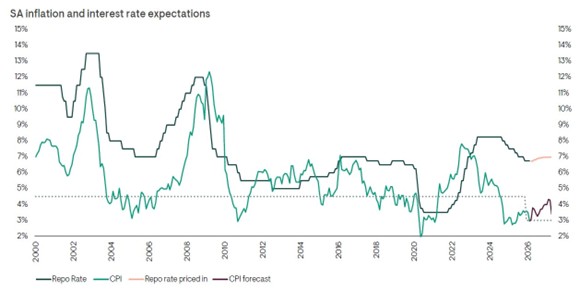
The chart below shows the South African repo rate and CPI inflation since 2000. Rates moved from above 12% in 2002 - 2003 and again in 2008 - 2009 to below 4% in 2020 - 2021, before climbing sharply as inflation spiked.
Your bond rate has probably already changed since you first started, and it will change again.
Source: NinetyOne Investments
There will be times when paying down your bond is more attractive, particularly when rates and inflation are high. At other times, investing becomes more compelling, especially when rates and inflation are low, and markets deliver strong returns.
When interest rates fall, many homeowners see their repayments decrease. However, it can be more beneficial to keep repayments steady rather than reduce them. By doing this, homeowners can build extra equity over time. This approach can leave them in a stronger position when interest rates rise again.
Practical guidelines
A useful starting point is understanding how much of your income is already committed to your bond.
South African banks apply a rule of thumb that bond repayments should not exceed 30% of gross monthly income. This is a useful personal benchmark, and the closer you are to that threshold, the more vulnerable you are to changes in rates, income, or unexpected expenses.
- Below 30%: You have flexibility to invest or accelerate repayment.
- Around 30%: You’re at the upper limit, and stability and buffers matter.
- Above 30%: You’re stretched, and reducing debt should be a priority.
This should be considered alongside your broader budget. If additional bond payments come at the expense of long-term savings or essential expenses, the trade-off becomes more complex.
Another consideration
Another factor to consider is your bond interest rate.
South African lenders compete actively for business, and a new lender will often cover transfer and registration costs. Even a 0,5% reduction on a R6m balance with 15 years remaining can save approximately R330 000 in total interest. This results in a guaranteed saving with no investment risk.
A lower interest rate also frees up cash, which you can then invest or use to repay this loan faster.
The bottom line
What we are trying to illustrate in this article is that the decision is nuanced, and it often starts with the wrong question.
Most people ask, "Where will I get the best return?"
But a more useful question is: what is important to me and what financial position do I want to be in if things don’t go to plan?
Rates will move. Income can change. Life has a way of surprising you.
A paid-down bond removes the emotional burden of debt and frees up monthly cash flow, creating greater flexibility. A well-funded investment portfolio, meanwhile, builds long-term growth and opportunity.
These aren’t competing ideas; they work together. The aim is to build enough flexibility into your financial life, so you’re not forced into a corner when circumstances change.
At Foundation Family Wealth, we help clients cut through the noise, get clear on what they’re trying to achieve, and make decisions that support the financial life they want and not just the one that looks best on paper.
<Foundation Family Wealth is an Authorised Financial Services provider>