
In a previous article, I introduced the Six Dimensions of Liquidity, a framework for understanding that liquidity is not simply cash, but a structured ecosystem of assets serving different purposes at different times. Now I want to bring that thinking into retirement.
When you stop working, your relationship with money changes fundamentally. You shift from accumulation to withdrawal. Income no longer arrives reliably each month from an employer or a business. Instead, you become the architect of your own cash flow. The decisions you make about where money comes from, in what order, and under what circumstances will shape your financial security for the rest of your life.
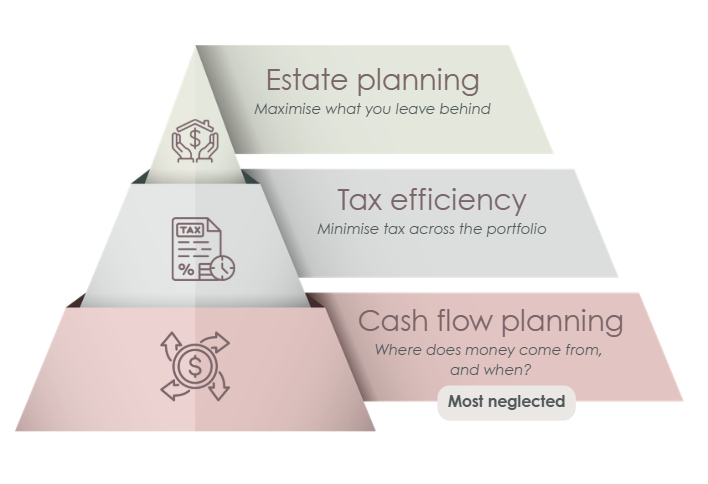
Apart from securing a life-long income, most retirement planning conversations focus on two things: minimising tax and maximising the estate. Both matter.
But there is a third pillar that is too often neglected: cash flow planning. Without it, even a well-structured, tax-efficient retirement portfolio can leave you asset-rich but cash-poor.
Source: Foundation Family Wealth
After retirement tax efficiency changes
During accumulation, the retirement pool consisting of your retirement annuity, pension or provident fund is the hero. It attracts tax deductions, grows in a tax-sheltered environment, and forms the engine of your long-term savings strategy.
At retirement, its character changes. It converts into a living or life annuity: a stable, structured income stream, but with significant constraints. Withdrawals are taxed at your marginal income tax rate. You cannot access a lump sum on demand. The retirement pool may be reliable from an income perspective, but rigid from a liquidity perspective.
This is why the non-retirement pool, made up of unit trusts, shares, exchange-traded funds, tax-free savings vehicles, and even endowments, becomes your most valuable tool in the withdrawal phase.
It offers flexibility, and growth is subject to capital gains tax, at a maximum of 18%, rather than income tax, at a maximum of 45%, making it efficient both as a source of regular income and for ad hoc withdrawals.
It can supplement retirement income in a tax-efficient way while remaining available for a car replacement, a trip you’d like to do, or a provisional tax payment. Although these ad hoc withdrawals must be planned, the funding is likely to be from flexible vehicles outside the retirement pool.
The liquidity pool including cash in your bank account or money market accounts remains your immediate cash buffer, accessible without delay or penalty, for unexpected expenses like medical bills.
You need both income and access
The central design challenge of a retirement portfolio is that you need two things simultaneously: regular income and accessible capital.
You need a regular income. A reliable flow that covers monthly living expenses without requiring constant decisions. The retirement pool provides this.
You need accessible capital. This means funds you can access for anything the income stream cannot cover. The non-retirement and liquidity pools provide this.
The mistake retirees make is optimising for one at the expense of the other.
Offshore is part of the pool
Many South African retirees, particularly those who have built up meaningful offshore assets, treat their global investments as untouchable: a legacy asset set aside for the next generation. Meanwhile, they draw everything from local assets.
The result is a steady depletion of local resources while the offshore sits idle. Over time, drawdown rates on local assets can rise, especially during adverse market conditions. And when local markets are down, the rand is typically weak as well, meaning offshore assets in rand terms are at their highest relative value. That is a good time to draw from offshore rather than local assets.
Offshore is not a separate kingdom. It is part of your integrated retirement pool. A European holiday is a foreign currency expense, and funding it from offshore is more realistic.
A new car could be funded by converting a portion of offshore capital at a time of your choosing. Managing drawdowns across your entire portfolio, including both local and global assets, supports long-term sustainability.
The retirement date is a liquidity structuring event
At retirement, you have a once-in-a-lifetime opportunity to withdraw a lump sum from your retirement savings. Most retirees, guided by tax-efficiency thinking, take as little as possible. This is understandable, but the framing is too narrow.
The more useful question is: what is the cost of not filling your accessible pools now, compared to the tax cost of filling them?
Once your savings are converted to a living annuity, the capital is permanently locked. A slightly higher tax payment at retirement, in exchange for well-funded non-retirement and liquidity pools, may be one of the most valuable decisions of your retirement. It establishes flexible, accessible capital from day one and reduces pressure on the retirement pool going forward.
Tax planning at retirement must also include tax payments. Retirees may move from PAYE to provisional taxpayer status, with payments due twice a year on fixed dates. Good cash flow planning ensures funds are available when needed.
Estate planning must take a backseat
Estate planning must come after cash flow planning and retirement funding, not before it.
Wealthy retirees often make decisions that protect the estate at the expense of their own comfort. They draw too conservatively to preserve capital for heirs or to avoid accessible structures for estate-efficiency reasons.
The reality is that people are living longer than any previous generation. A healthy 65-year-old couple today has a reasonable probability that at least one partner will reach 90 or older. That is a 25-year retirement to fund. Most retirees, even wealthy ones, will consume most of their capital over that period. That is not failure, that is the plan working.
The first obligation of a retirement portfolio is to the person who built it. What remains after a well-lived, well-funded life is the inheritance.
Plan the flow, not just the shock
Good retirement planning is not only about how much you have. It is about how the money moves from different sources, in what order, at what rate, and under what circumstances.
Ask yourself the question that matters most: when I need money next month, next year, or in five years, where exactly will it come from?
That is the question cash flow planning answers. And it is the question every retirement plan should be built around.
At Foundation Family Wealth, we help clients design retirement portfolios that balance regular income with genuine accessibility, integrate offshore assets as an active part of the drawdown strategy, and plan for the full reality of a long retirement. Get in touch if you would like to talk about your retirement cash flow plan.
<Foundation Family Wealth is an Authorised Financial Services provider>